News from the Commons
3rd March 2026
While January seemed to last 365 days, February seemed to flash by, meaning we had to work very quickly to finish all of our Winter work programme tasks and projects, including work to plant all of our new disease resistant elm trees.
We’re all familiar with the sad stories surrounding ash dieback and its impact on our trees, but we have some encouraging elm news that offers cautious hope for the future.
Dutch elm disease has had a profound and lasting impact on woodland across the UK. First identified in the mid-20th century, the disease, spread by elm bark beetles, wiped out millions of mature elm trees, dramatically altering landscapes that had been shaped by elms for centuries. Once a defining feature of hedgerows, village greens, and lowland woodland, elms declined rapidly, leading to the loss of wildlife habitats and changes in woodland structure and biodiversity. Although young elms continue to regenerate, most succumb to the disease before reaching maturity.
In 2024, we were approached by Kent County Council’s Plan Tree team, inviting us to join their disease resistant elm tree programme. During early 2025 we planted 13 trees on the Commons, only losing 1 tree to the deer! From small seeds a great project began to grow, and this year we have 33 disease resistant trees that have been planted on both Commons, along with 100 woody shrub saplings. Green protective sleeves around our trees are popping up wherever you look!
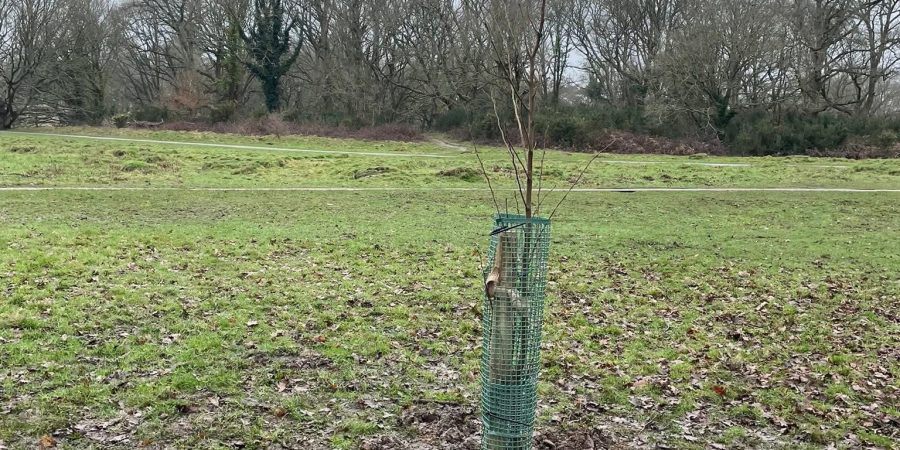
Disease resistant elm trees recently planted on the Commons
With invaluable support from William Malpas, of Butterfly Conservation Kent, we have also now identified healthy elm trees that are currently showing some field resistance to the disease. Amongst these, are six rare and unusual mature examples of the historic clone Ulmus ‘Belgica’. These six trees are thought to have been planted in the early 20th Century or possibly even Victorian era. When Dutch Elm Disease struck during the 1970s and 80s they were cut down en masse, regardless of their condition, and the vast majority disappeared for good. However, fast forward to today and these trees have regrown from the original stumps to good-sized, beautifully stunning examples again. We are extremely keen to try to protect all of the surviving elm trees on the Commons and have taken proactive steps to manage their immediate habitats and plant new resistant species in close proximity. But given the rarity of mature specimens of Ulmus Belgica, we are actually now investigating vaccinating the trees, an approach that has been successful in Brighton and Hove. Since 2023, around 1,400 elm trees in their parks and open spaces have been injected with a biological vaccine called DutchTrig to stimulate their natural defence against elm disease. In my next update I hope to bring you further good news on this project.
I can’t finish the monthly blog without another mention of the Friends of the Commons and their tireless campaigning to try to buy the Commons for the community from the existing commercial owner. Please do pop over to www.friendsofthecommons.uk to find out more and if you can, to pledge your support. Ownership determines long-term stewardship, and this feels like a rare moment where the community has a real say in that future.
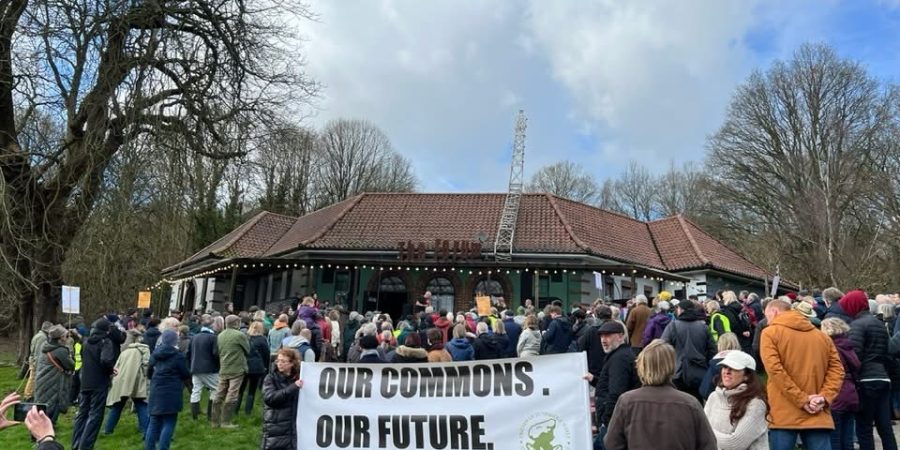
The community at a recent solidarity march, supporting the Friends of the Commons’ bid to buy the Commons for the community.